

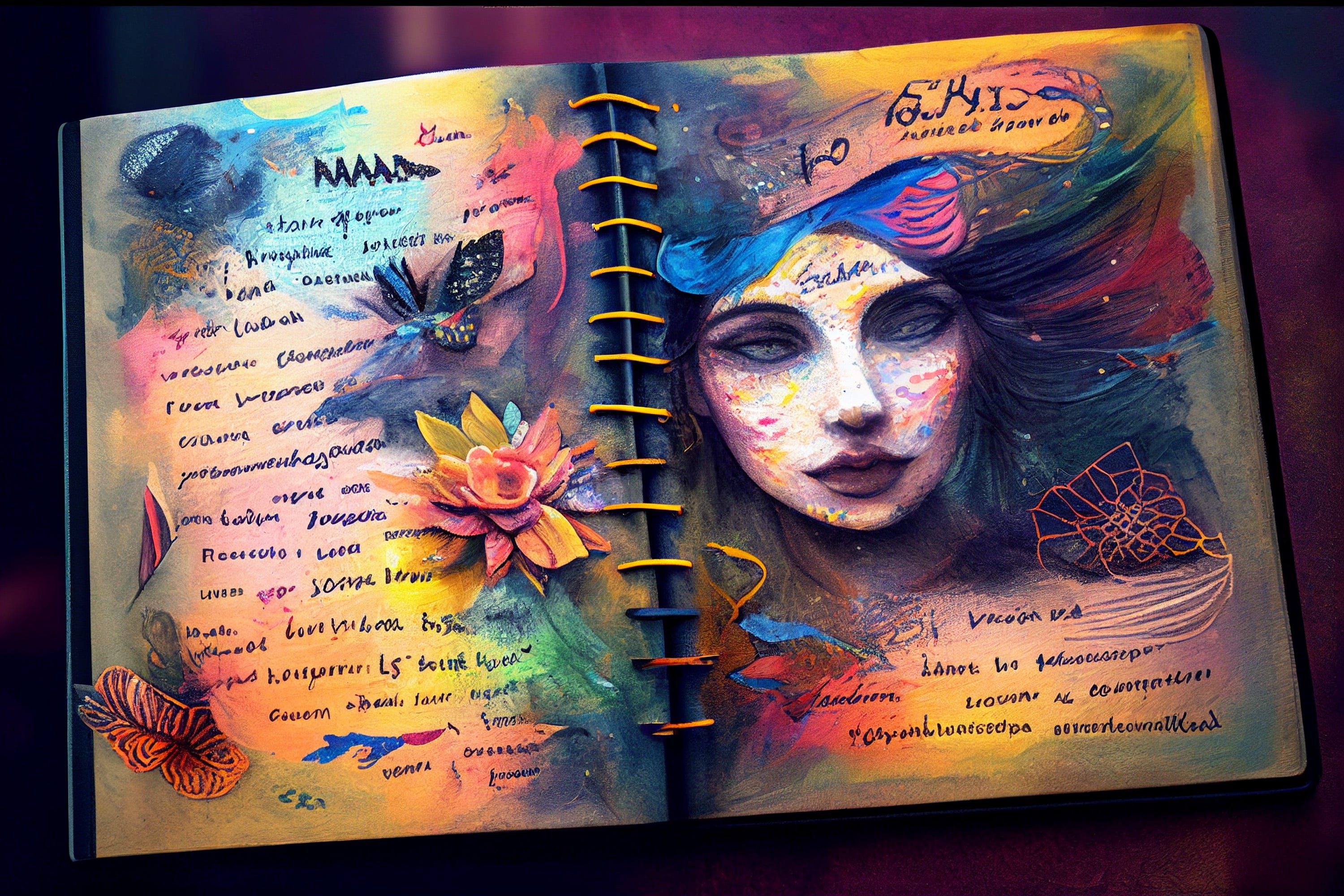
I remember when we were little kids, they used to say in the community where I live: Girls write in their diaries, men talk to their friends about their problems. This short phrase, and ultimately social stereotype, had a huge impact on an entire generation. Perhaps not so much on Gen Z as on Millennials.
You see, writing in a diary, whether on physical paper with a pen and pencil, on a computer in Word, or simply in an app, is a great way to do many things. It is clearly not intended for just one gender and is a universal human need for expression and creation. But let’s take a look at them in order:
Journaling: The art of expression
Through writing, we express ourselves. We express our feelings. And this can be liberating. It can help us understand ourselves better and gain insights and clarity that we would not have if we did not write in a journal.
Also, in intense situations, it is clearly more functional and gentle to write than to react to other people, who in the end are not to blame for anything.
Through expression, you are also entertained, because through ready-made templates you can see various things about yourself, relax, or simply go with the flow.
Writing develops you
The great “gurus” of self-improvement said: Set goals. On paper and with a pen. And that way, you will achieve them. I would say, set goals. Wherever you want. But if they are achievable, written down, and realistic, you are more likely to grow and achieve them.
Not to mention that writing can help you make weekly or monthly reports and see why something is going right or wrong, see why something is going a certain way, and draw more conclusions for yourself personally.
Writing is therapeutic
If you suffer from depression, bipolar disorder, or PTSD, the first line of help is a mental health professional and, if necessary, medication. This is non-negotiable.
However, journaling can really relieve your anxiety and rumination, or thinking about something over and over again. It can help you feel relief and give you motivation or a push to do other things in your day, since you’ll say, “I did this, so I can do something else.”
Does it matter where you write?
The truth is, no. What matters is that you like where you write and that you feel inspired. Whether it’s an app, Word, or pen and paper.
What if I can’t write/I’m not good at writing?
Good question. And very pertinent. The answer is: If you are an auditory learner, record yourself with audio notes or voice messages to keep a kind of diary (here I recommend using an app for privacy reasons).
If you are a visual learner, you can either draw it or ask A.I. to describe your words with images (always being careful not to include sensitive personal data in it).
Finally, if you are a kinetic person, you can exercise or do some kind of movement while taking audio notes or writing, combining the two above forms.
Conclusion
Writing is for everyone. It is liberating and can indeed help in many ways. Of course, it is important to do as much as we can “handle” in each session and not push ourselves too hard.
Ultimately, we do it for ourselves, to ourselves, as a gift to ourselves. And if it helps with anything? Better awareness, less stress, and better well-being.
And if you haven’t learned how to journal, don’t worry. You’re not alone. I’m sure you can do it. Little by little, with practice, it will become easier and easier. Until you see that it comes easily and liberatingly to you.